

The most significant change in China’s phosphate fertiliser market in the first half of 2026 is that exports and domestic demand swapped places. Phosphate fertiliser export volumes fell sharply once export controls took effect in mid-March, while apparent domestic consumption moved the other way. For upstream phosphate rock, downstream demand did not vanish along with exports — it simply went somewhere else.
1. Exports: A Sharp Fall Once Controls Landed
From 14 March 2026, China imposed phased export controls on agricultural phosphate fertilisers and phosphate-containing compound fertilisers, covering monoammonium phosphate (MAP), diammonium phosphate (DAP), single superphosphate and agricultural compound fertilisers, applied as “zero inspection applications, zero approvals, zero releases”. The policy showed up plainly in the monthly data: DAP recorded only sporadic exports in January, February and June 2026, and none at all in July.
According to the SCI99 report “January–July Exports: Nitrogen Up, Phosphate Down in the Fertiliser Chain” (2 September 2026) and customs data, China exported 113,000 tonnes of MAP in January–July, down 487,900 tonnes or 81.19% year on year. DAP exports totalled 73,900 tonnes over the same period, down 1,509,400 tonnes or 95.33%.
The controls expired on schedule on 31 August and normal export declarations resumed on 1 September, but the reopened regime still runs on a “licence plus annual quota” model. Phosphate Fertiliser Exports Resume on 1 September: From Six Months of Controls to Licences and Annual Quotas unpacks the quota allocation logic, the zeroing of export rebates and the three statutory inspection hurdles in more detail.
2. Domestic Demand Takes Over, and Rock Demand Holds
While the export channel was closing, domestic consumption was filling the gap. On the same customs basis, July apparent consumption of MAP reached 965,100 tonnes, up 34.81% year on year; the January–July total came to 6,662,900 tonnes, up 9.59%. DAP rose far more sharply, with July apparent consumption of 905,800 tonnes, up 266.53% year on year.
Port stocks tell the same story. At the end of July, major Chinese ports held no MAP inventory at all, while DAP stocks stood at 29,500 tonnes, down 220,500 tonnes or 88.20% year on year. The material was not sitting in port waiting for a vessel; it had moved into the domestic market.
For phosphate rock buyers, the meaning of these figures is that the base of downstream operating activity is still there. What keeps rock prices steady is domestic demand, not exports. When judging where prices go next, domestic phosphate and compound fertiliser operating rates are worth watching more closely than export quotas.
3. The Value Case for High-Grade Middle East Rock
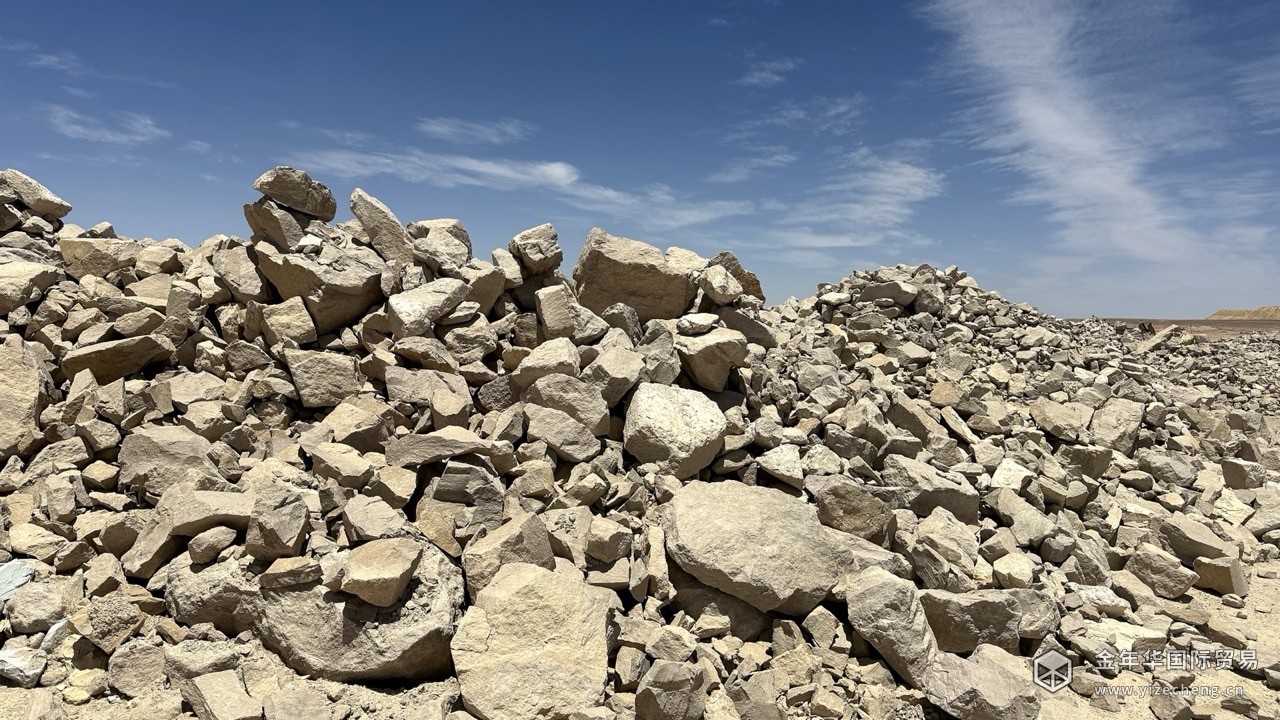
China’s resource structure means imported high-grade rock has always had a place. Around 90.8% of Chinese phosphate rock is medium or low grade, with an average grade of only 17%–18%, and operating mines generally face falling grades and rising beneficiation costs. Securing a steady supply of material above P₂O₅ 30% is difficult to achieve without imports.
Middle East supply has two advantages: consistent grade and a relatively controllable impurity profile. Sedimentary phosphorite from Jordan and Egypt has been blended into Chinese plant feed systems for years, so process compatibility is easier to verify than with a new source. There is an additional change this year: China has classified rock with P₂O₅ of 30% or above as a strategic resource and in principle discourages raw ore exports, which will make imported high-grade rock scarcer still. That shift is set out more fully in After the High-Grade Phosphate Rock Export Ban: How Import Procurement Adjusts.
Value for money has to be assessed on a full delivered-cost basis. One grade band up may mean a step up in the quoted price, but impurities, moisture, particle size distribution and freight can turn the conclusion around. More Than One Kind of Phosphate Rock: Rock Phosphate, Sedimentary Phosphorite and Grade Classification offers a comparison framework with a single message: do not compare on the P₂O₅ number alone.
4. What Procurement Teams Should Watch Next
- Quota and licence rules. These determine how much volume can be exported after September, and therefore the pace at which fertiliser plants run.
- Actual Q4 shipment data. Resuming declarations is only the customs step; enquiries, contracting, port consolidation and loading all take time, and the industry consensus is that large shipments will not concentrate until mid to late October.
- Sulphur and phosphate rock price lines. Sulphur sets the cost, rock prices determine whether marginal capacity can run, and together they set producers’ willingness to operate.
- Whether domestic consumption holds. Growth in first-half apparent consumption is the main support under rock prices; if that line weakens, export quotas will not offset it.
Conclusion
Export volumes did fall in the first half, but phosphate rock demand did not collapse with them, because domestic consumption took over. For buyers of imported high-grade rock, the near-term focus belongs on domestic operating rates, phosphate rock prices and sulphur prices; export quotas themselves move much more slowly. Export recovery is a slow variable, whereas quotations and ocean freight are fast ones.
Related Reading
Phosphate Fertiliser Exports Halved: MAP Down 81.19% in January–July
After the High-Grade Phosphate Rock Export Ban: How Import Procurement Adjusts
Phosphate Rock Market Outlook 2026: Tight Supply, High Prices and Procurement Response