

Most phosphate rock ends up in a fertiliser plant, but not all of it, and the exceptions carry a disproportionate share of the value. World mine production was 250 million tonnes in 2025, up from 239 million the year before (USGS, Mineral Commodity Summaries 2026, February 2026). Of that, roughly 9.2 million tonnes — 3.7% of the total — bypasses fertiliser entirely and goes to electric furnaces for elemental phosphorus. That 3.7% carries about 8.7% of the market’s value and supplies almost every non-fertiliser phosphorus molecule in commercial use (Pheonix Research, October 2026).
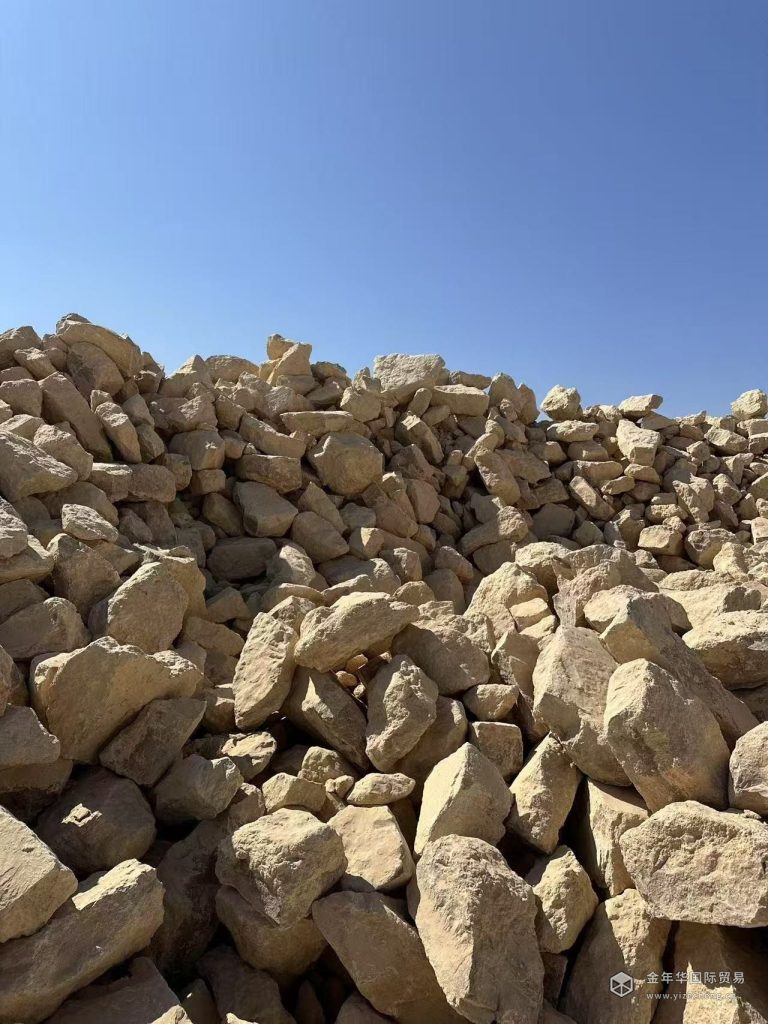
For a buyer, the useful question is not “what is phosphate rock used for” in the abstract. It is which of those end uses a given parcel can actually serve, because the answer determines the specification, the price and the counterparty.
Composition first: apatite, P₂O₅ and the BPL conversion
Phosphate ore composition is dominated by fluorapatite, Ca₁₀F(PO₄)₆, sitting in a sedimentary or igneous matrix. It is largely insoluble, which is the whole reason it must be chemically converted before crops or industry can use the phosphorus. In the ground it sits with calcite, dolomite, quartz, clay and iron oxides, and those companions are what turn a simple grade number into a specification.
Trade runs on the P₂O₅ equivalent. A “28% rock” contains about 28% phosphorus pentoxide. The older BPL (bone phosphate of lime) basis still appears on some assays and legacy contracts; BPL multiplied by 0.4576 gives P₂O₅. Mixing the two bases in one comparison is an easy way to misprice a cargo by several percentage points.
Impurities decide the destination. Cadmium is the one that gets regulatory attention: the tightest current fertiliser rules cap it at 60 mg/kg P₂O₅, and buyers in sensitive markets write that ceiling into contracts with penalty clauses. Magnesium oxide raises acid consumption, silica adds grinding and filtration load, iron oxide affects brightness and downstream purification, and moisture drives both freight economics and cargo behaviour on a long sea passage.
Fertiliser: around 96% of the tonnage
The main line is rock to phosphoric acid by the wet process, where sulphuric acid digests the ore, and then to monoammonium phosphate (MAP) or diammonium phosphate (DAP), or directly to triple superphosphate (TSP) and single superphosphate (SSP). Direct application of ground rock exists but is marginal; the phosphorus is not readily available to plants in that form.
Buyers here are fertiliser producers, blenders and import traders. Mainstream import grades sit at 28% P₂O₅ and above, but grade alone does not close a deal. A producer running a wet plant cares about acid consumption per tonne of P₂O₅, which is driven by carbonate content, and about the cadmium load in the finished fertiliser, which is driven by the ore. Moisture matters more than buyers expect: ore that arrives caked has to be broken out at the berth, and that cost lands on somebody.
Production is concentrated. In 2025, China produced 110 million tonnes, Morocco 36 million, Russia 14 million and Jordan 12 million, with the balance coming from a short list of other producers (USGS, February 2026). China holds roughly 4.7% of reserves and produces about 44% of output; Morocco holds about 68% of reserves. That mismatch is why export policy in a handful of countries moves the availability of high-grade rock for everyone else.
Acid and industrial phosphates: small tonnage, high value density
The 9.2 million tonnes that go to electric furnaces become yellow phosphorus, then thermal phosphoric acid. The thermal route is electricity-intensive: power is about 20.84% of yellow phosphorus cost (Pheonix Research, October 2026), which is why run rates track energy availability rather than ore availability. Chinese weekly output moved from 17,094 tonnes at 54.49% utilisation on 13 March 2026 to 22,140 tonnes at 67.36% on 8 October 2026, with provincial rates in Yunnan, Guizhou and Sichuan diverging by several points.
Downstream, the phosphate family is wide: sodium tripolyphosphate for detergents, now partly restricted in several markets; water-treatment chemicals; flame retardants; ceramic dispersants; and the food and feed phosphates discussed below. Buyers in this segment are chemical plants, water utilities and consumer-goods manufacturers, and their specifications are about heavy metals, arsenic, fluoride, Ca/P ratio and dissolution behaviour, not about P₂O₅ headline grade.
Feed and food grade: small volume, strong pricing power
Feed-grade dicalcium phosphate (DCP) and monocalcium phosphate (MCP) are the main supplementary phosphorus sources for livestock, and demand follows the livestock cycle more than the fertiliser cycle. Food-grade phosphoric acid and phosphates go into beverage acidulants, meat processing and toothpaste abrasives, where the barriers are heavy-metal and arsenic limits plus plant hygiene standards.
The requirement here is cleanliness rather than high grade. The same P₂O₅ content can enter the food chain from one deposit and be limited to fertiliser from another, purely on impurity profile. That is why assay data, not origin reputation, should drive the routing decision.
Lithium iron phosphate: a new draw on the same rock
LFP cathode material is made through iron phosphate (FePO₄) precursor, which traces back to phosphoric acid and then to rock. Pheonix Research sizes the battery-grade phosphate pool at about 2.75 million tonnes, drawing roughly 10.12 million tonnes of rock — about 3.7 tonnes of ore per tonne of battery-grade product. Per unit of finished material, the battery chain pulls more rock than an equivalent fertiliser tonne, which is why battery demand registers upstream out of proportion to its volume.
Battery grade is a real gate, not a marketing label. Iron phosphate for cathodes is specified on Fe/P ratio, magnetic particle counts, sulphate and chloride, all far tighter than fertiliser grade. Standard fertiliser rock does not substitute for battery-grade feedstock; purification and synthesis sit in between.
This is where a common misreading occurs. Tight phosphate rock supply does not mean tight battery-grade phosphate supply, and a rising rock price does not automatically lift battery-grade prices by the same amount. The two markets share a mine but not a cost curve. Readers tracking the price relationship can follow our market watch updates.
Matching the parcel to the end use
Laid out side by side, the four routes produce a simple decision matrix. For fertiliser, the controlling variables are P₂O₅, cadmium, moisture and granulometry. For industrial phosphates, they are iron, arsenic, fluoride and brightness. For battery grade, magnetic particles and sulphate dominate. For feed and food, full heavy-metal panels and plant certification decide.
Three misconceptions are worth naming. The first is pricing on P₂O₅ alone and ignoring penalty clauses; the delivered cost after deductions can exceed a higher-priced, cleaner parcel. The second is treating origin as a proxy for quality: Safaga in Egypt and Aqaba in Jordan are both established loading ports, and lot-to-lot variation exists at both, so the assay decides. The third is comparing FOB numbers as if they were delivered costs.
We source phosphate rock directly from Egyptian and Jordanian mines and ship worldwide through our Dubai entity, with no transit through China. Origin and specification pages for Egyptian phosphate rock and Jordanian phosphate rock set out the loading and grade basics, QC and assay reports explains how to read the documentation, and the minerals portfolio lists current grades. If you have a target end use and a monthly volume, send the parameters and we will match them against available parcels.
FAQ
Can phosphate rock be applied directly as fertiliser? Ground rock is used on acidic soils in some regions, but efficiency is low compared with processed fertiliser. Commercially, the overwhelming majority of rock is acidulated first.
Is a higher P₂O₅ grade always better? For fertiliser, broadly yes. For industrial and battery applications, a cleaner mid-grade parcel can outperform a high-grade one carrying impurities that disrupt the process.
Why do two parcels from the same origin price differently? Grade, impurity profile, moisture and granulometry vary by lot, and each affects downstream yield and handling cost. Sellers quote on their own assay, buyers accept on theirs, and the gap between the two is what penalty clauses exist to settle.