

The “Ore Price” on a Quotation Is Not One Single Thing
The most common way a price comparison goes wrong is subtracting one quotation from another without checking the terms behind them. One supplier quotes FOB, another quotes CIF, and the gap between the two is ocean freight, insurance and a slice of risk liability. Left unbroken, that gap tells you nothing about who is actually cheaper.
The arithmetic itself is covered in How to Calculate the Landed Cost of Imported Phosphate Rock: From USD 85/t at Port, How Much Freight and FX Take. This article deals with the terms only: what each side carries, the exact moment risk transfers, and a cost checklist you can put to work as it stands.
Three Terms, Four Lines of Responsibility
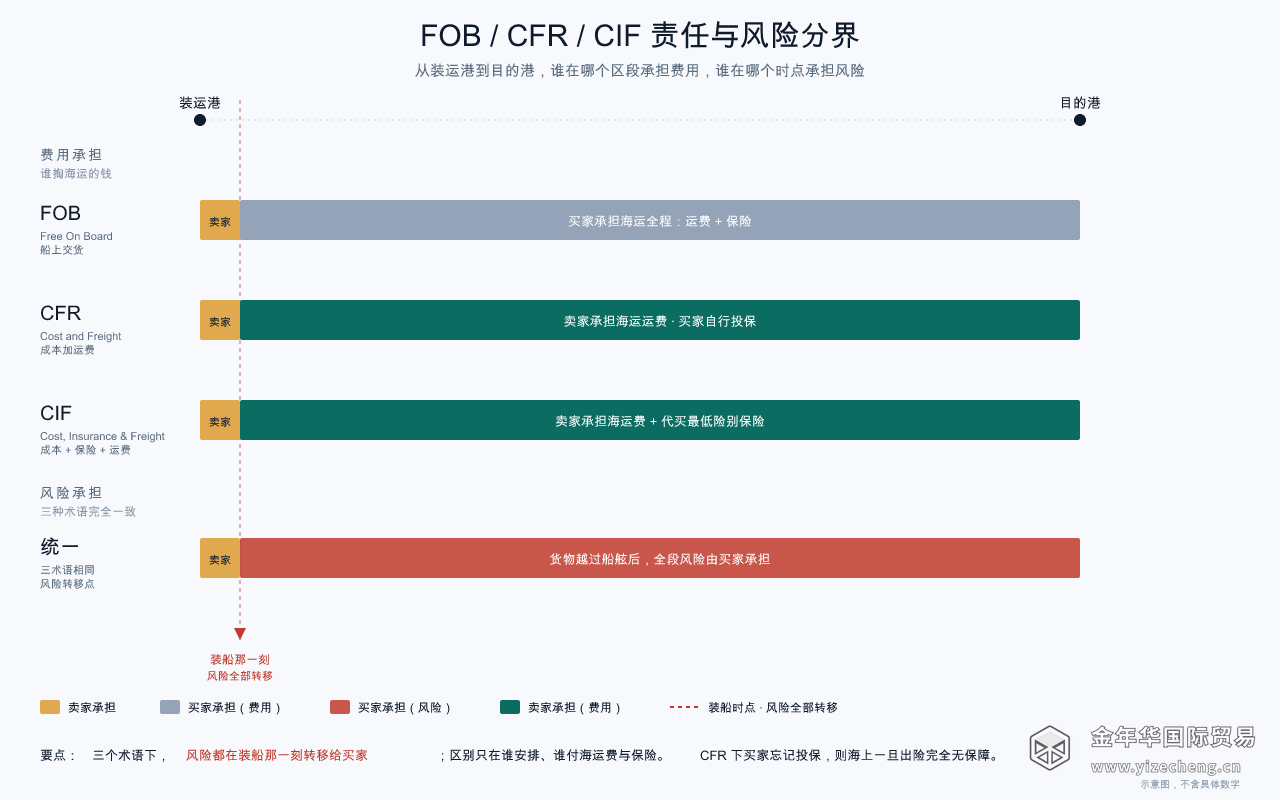
FOB, CFR and CIF apply only to sea and inland waterway transport. Their differences come down to four questions: who books the vessel, who pays the freight, who buys the insurance, and the moment risk passes from seller to buyer. The first three govern money; the fourth governs who carries the loss when something goes wrong. Buyers who watch only the first three tend to get caught by the fourth.
- FOB (Free On Board): the seller delivers the goods on board the vessel at the port of shipment, and all costs and risk up to that point stay with the seller. Once the goods are on board, international freight, insurance, destination port charges and all risk pass to the buyer together. The buyer holds the logistics initiative, and carries the heaviest administrative load.
- CFR (Cost and Freight): the seller takes on one more leg than under FOB, booking the vessel and paying freight to the destination port, but does not buy insurance. Risk still transfers the moment the goods are loaded.
- CIF (Cost, Insurance and Freight): the seller pays freight and arranges insurance at the minimum cover level. Risk again passes to the buyer on loading.
Moving from FOB to CFR to CIF, the seller’s obligations step up and the quoted price rises with them. The point at which risk transfers, however, is identical across all three.
Risk Transfers at the Moment of Loading
This is what the three terms share, and it is the most counter-intuitive part. CIF sounds as though the seller is responsible all the way to the destination port, yet risk has already passed to the buyer on loading: if the cargo is lost or damaged at sea, the buyer absorbs the loss first and then claims on the insurance policy the seller arranged.
- CIF is not “delivery at the destination port”. Buying on CIF does not mean you can ignore transit risk; where the policy covers only the minimum, anything above that remains your exposure.
- Under CFR the seller buys no insurance. If the buyer forgets to arrange cover, a casualty in transit leaves the shipment entirely uninsured. That is the most common and most expensive oversight in CFR trades.
Two Cost Levels: Landed First, Then Delivered to Plant
Split costs into two levels and price comparison gains a single basis.
Level one: landed cost (goods at the destination port terminal, before the domestic leg)
Landed cost = CIF price + import duty + import-stage VAT + destination port charges + inspection, quarantine and document-swap fees
If you hold an FOB or CFR quote, build it up to CIF before going any further: CIF price = FOB price + international freight + insurance, or CFR price + insurance. This step cannot be skipped.
Level two: delivered-to-plant cost (the final decision basis)
Delivered-to-plant cost = landed cost + inland transport from port to plant + handling and storage + cost of capital tied up
The figure you can compare against domestic material and other suppliers is delivered cost per tonne, not the bare ore price on the quotation.
How the Taxes Are Calculated: The Dutiable Value Follows CIF
- Import duty: the customs dutiable value multiplied by the applicable rate. The dutiable value is normally determined on the CIF price.
- Import-stage VAT: levied on (CIF price + duty). For general VAT taxpayers this input tax is creditable later, so cash-flow projections should net off the creditable portion. Otherwise you overstate the funding pressure.
- Practical note: FOB purchases must also be built up to CIF with freight and insurance before duty is calculated. Applying the rate straight to an FOB price understates the tax base.
Tariff lines and duty rates for ore categories are adjusted year by year, and some categories qualify for low or preferential agreement rates. Check the current year’s tariff schedule before you model costs.
Hidden Costs That Get Missed
Most comparison failures come from omitted line items, not arithmetic errors. Turn the checklist below into a standard cost sheet and tick off every entry against each quotation:
- Port construction fees, port charges and terminal handling charges (THC)
- Storage at the destination port, plus container demurrage and vessel detention once the free period expires. This is the line item that grows fastest
- Third-party inspection fees and draft survey charges at both loading and discharge ports
- Foreign exchange translation loss (arising when the quote currency differs from the payment currency)
- Demurrage and despatch (laytime penalties and rewards under a charter party)
- Letter of credit issuance fees, cable charges and amendment fees for discrepancies
- Cost of capital tied up (interest over the period from payment to sale of the goods or completion of the VAT deduction)
- Domestic road or rail haulage, handling and short-distance transfer charges
FOB or CIF: It Depends on Your Logistics Capability
- Choose FOB if you know the route, can obtain better freight rates, or want to control the forwarder and insurance yourself. The price is that all logistics administration lands on you, and you must remember to buy your own cover.
- Choose CIF if you want simplicity, the supplier has strong logistics capability, or the order is urgent. The price is that the freight carries the seller’s margin, the insurance covers only the minimum, and any cargo claim has to be pursued through the seller as the policyholder.
- Practical advice: ask every supplier to quote CIF to the same destination port, establish a comparable baseline, then break it back down. You will see immediately whose ore price is genuine and whose freight is padded.
Exchange Rates: Put Volatility into the Comparison Sheet
Ore is usually quoted in US dollars and paid in renminbi, so currency moves eat straight into margin. For long-term agreements, fix the pricing currency and the adjustment mechanism in the contract; for spot purchases, hedge before payment with forwards or similar instruments. Add a separate FX sensitivity column to your comparison sheet so you do not book a profit and lose it on settlement.
Compare Quotations in This Order
- On receiving a quote, confirm the Incoterms version and the named port first (the 2020 and 2010 versions divide responsibility differently).
- Convert quotes on different terms to a single basis, preferably delivered cost per tonne.
- Work through the standard cost sheet item by item to avoid omissions (see the eight-item list above).
- Record long-term and spot prices separately, and watch how freight volatility magnifies landed cost: when the ore price is low, freight takes a larger share.
- Fix payment and delivery schedules, and carry the cost of tied-up capital into the total.
Without a common set of terms, no amount of detail in a quotation makes it comparable.
Related Reading
- How to Calculate the Landed Cost of Imported Phosphate Rock: From USD 85/t at Port, How Much Freight and FX Take
- A Buyer’s Guide to Phosphate Rock: Grade Pricing, Quality Penalties and Delivered Cost
- Bulk or Container Shipping: Which Saves More?
- Customs Clearance for Mineral Imports: The Document Checklist