

Iron oxide yellow is the workhorse of the yellow pigments. It turns up in coloured concrete and paving, in architectural and industrial coatings, in plastics, rubber and paper. The difficulty in procurement is rarely availability. It is that “iron oxide yellow” on an enquiry can mean several quite different products, and the quotation that comes back may not be for the grade you had in mind.
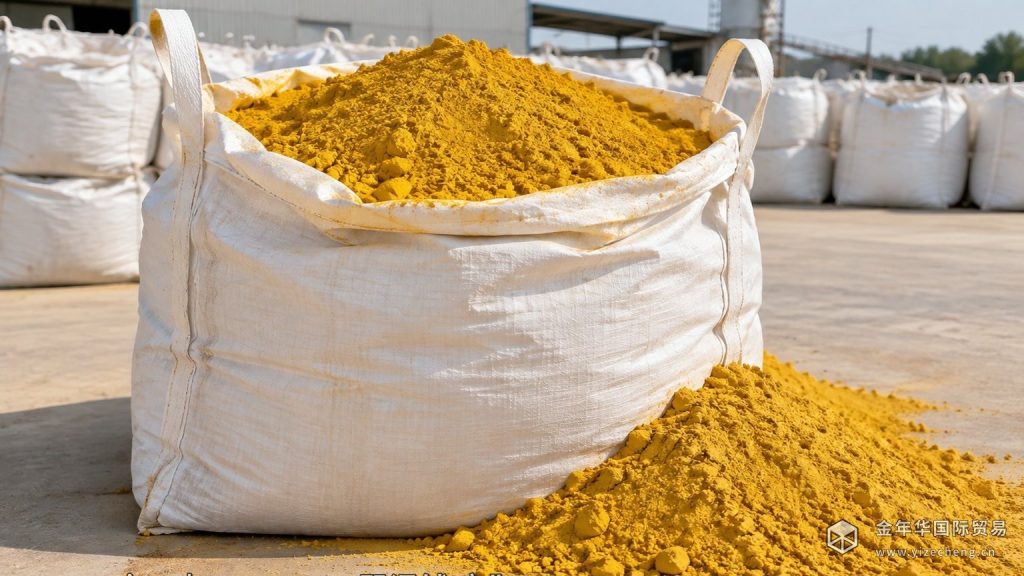
What iron oxide yellow actually is
Chemically it is goethite — iron(III) oxide hydroxide, α-FeOOH. In the Colour Index it carries the code Pigment Yellow 42 (C.I. 77492), and its CAS number is 51274-00-1. “Iron yellow” and “yellow iron oxide” are trade shorthand; the formal name is iron oxide yellow.
It is not interchangeable with iron oxide red (whose main component is Fe2O3) or iron oxide black. Hue, heat resistance and tinting strength all differ, and a formulation built around one will not accept another without adjustment.
The Chinese national product standard is GB/T 1863-2008, Iron Oxide Pigments, a modified adoption of ISO 1248:2006. It was issued on 4 June 2008, took effect on 1 December the same year, and replaced GB/T 1863-1989; a review in March 2025 confirmed it remains in force. Its scope covers pigments with Colour Index numbers Red 101 and 102, Yellow 42 and 43, Brown 6 and 7, and Black 11. Micaceous iron oxide, transparent iron oxides and granular iron oxide grey fall outside it. An enquiry that says only “iron oxide yellow” therefore leaves the supplier no way to tell which grade you want.
Grades: 313 is the volume standard, not the only one
Iron oxide yellow usually travels under three-digit grade codes. 313 is the largest-volume general-purpose grade, alongside variants such as 313S, 313H, 312 and 314. Naming is not standardised across producers, and two products carrying the same code can still differ in hue and tinting strength.
Grade differences run in three directions: hue (leaning lemon or leaning brown), relative tinting strength, and dispersibility. “313” alone on a request for quotation is usually not enough. At minimum, state the hue requirement, the tinting strength range and the application system. Without those three, you will spend your comparison on differences that are not real.
What to check on the certificate of analysis
Under the framework of GB/T 1863-2008, iron oxide pigment specifications divide into basic requirements and agreed conditions. In practice the ranges below are common in the market; specific limits are settled between buyer and seller.
- Content (expressed as Fe2O3): general-purpose grades commonly specified at 86% or above
- Oil absorption: typically 25–35 ml/100 g, though some producers publish 15–25 on a g/100 g basis
- Residue on sieve: at 325 or 400 mesh, commonly 0.3%–0.5% maximum
- Matter soluble in water: commonly 0.3% maximum, some products 0.5%
- Moisture: 1.0% maximum
- pH: commonly 3–7
- Relative tinting strength: 95%–105% against the standard
- Colour difference: ΔE not greater than 1.0 against the standard
- Density: true density about 4.1 g/cm³, bulk density commonly 0.4–0.6 g/cm³
One detail causes more confusion than any other. Oil absorption is reported on either a ml/100 g or a g/100 g basis depending on the producer, and the numeric ranges differ accordingly. Align the unit and the test method before comparing two quotations, or the conclusion will be wrong in the direction that matters.
Applications: from coloured concrete to plastics and rubber
Construction is the largest outlet. Coloured concrete, coloured flooring, paving blocks, coloured asphalt, terrazzo, artificial marble and wall tinting all consume it, with cement products typically dosed at 3%–5%. Weather resistance and alkali resistance matter most in these uses, because the alkaline environment genuinely tests pigment stability.
Coatings are the second-largest outlet: water-based interior and exterior paints, powder coatings, and primers, fillers and topcoats in alkyd, amino and epoxy systems, along with toy paints, furniture lacquers, electrophoretic and magnetic coatings. There is one hard limit here. Iron oxide yellow is not suited to systems above 170°C. Where baking ovens or some powder coating cures run hotter than that, the hue shifts noticeably, so confirm your cure temperature at the specification stage.
In plastics and rubber it appears in automotive inner tubes, shoe soles, gloves, stationery, medical devices and brake pads. Paper and leather use yellow grades to give the substrate its base colour and improve lightfastness; ceramics, printing inks and metal flaw detection also use it. In practice iron oxide yellow is often blended with iron oxide red, black and brown to hit a target shade, so a buyer who matches a single pigment in isolation may still end up with a finished colour that does not match.
Handling, storage and regulatory status
Under EU REACH (EC 1907/2006) and CLP (EC 1272/2008) classifications, iron oxide yellow is not classified as a hazardous substance, and it does not dissolve in water or organic solvents. It ships and stores as ordinary cargo.
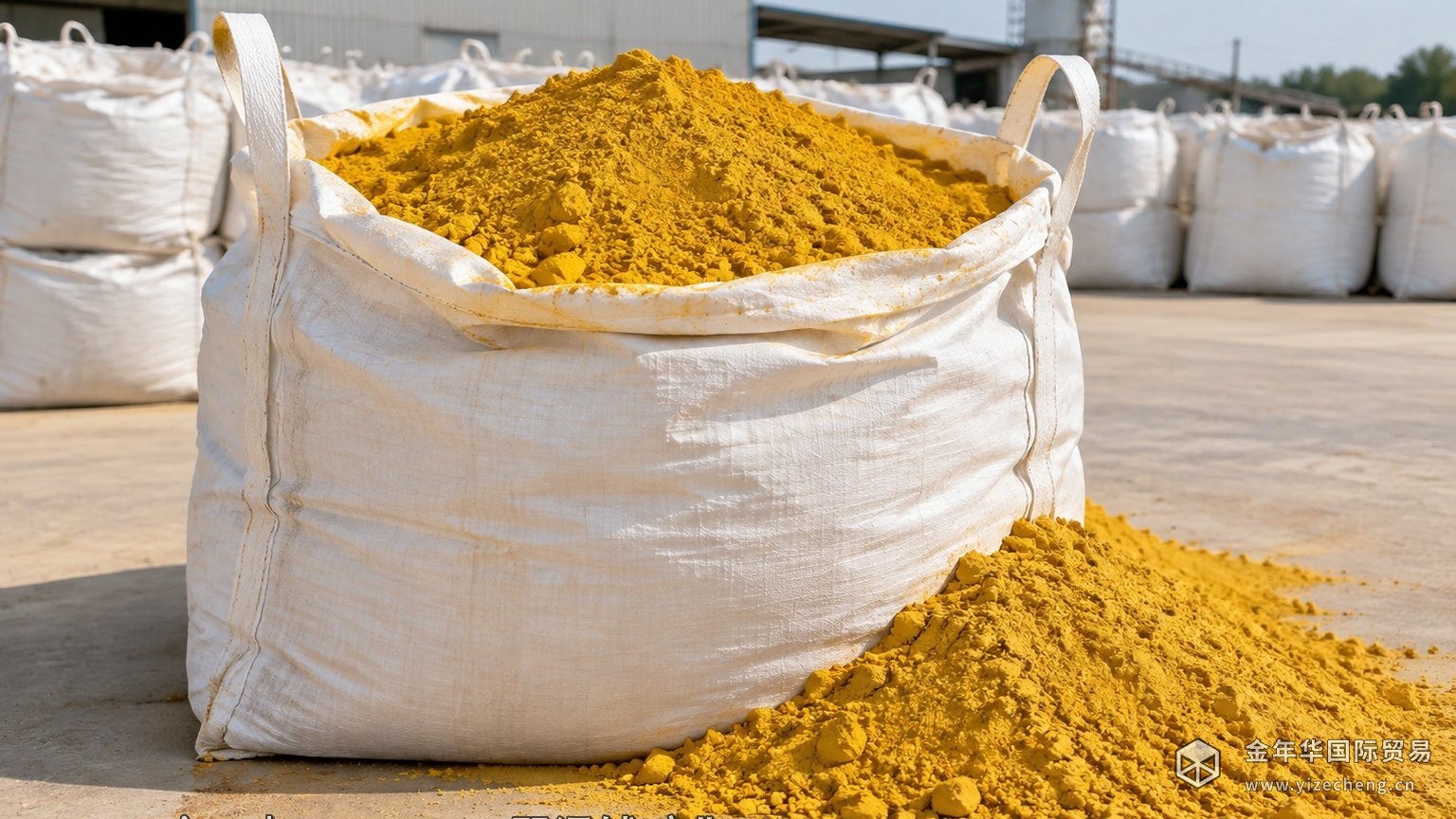
Not being hazardous is not the same as having no handling requirements. As a powder it still calls for dust control during charging and packing, and workers should not breathe the dust. In storage, moisture and sunlight are the two things to watch. Once it cakes from damp, dispersion suffers, and both the cost of breaking it up and the residue-on-sieve figure get worse. The usual packaging is 25 kg paper or woven bags, with bulk bags also available; store in a dry place.
Common questions
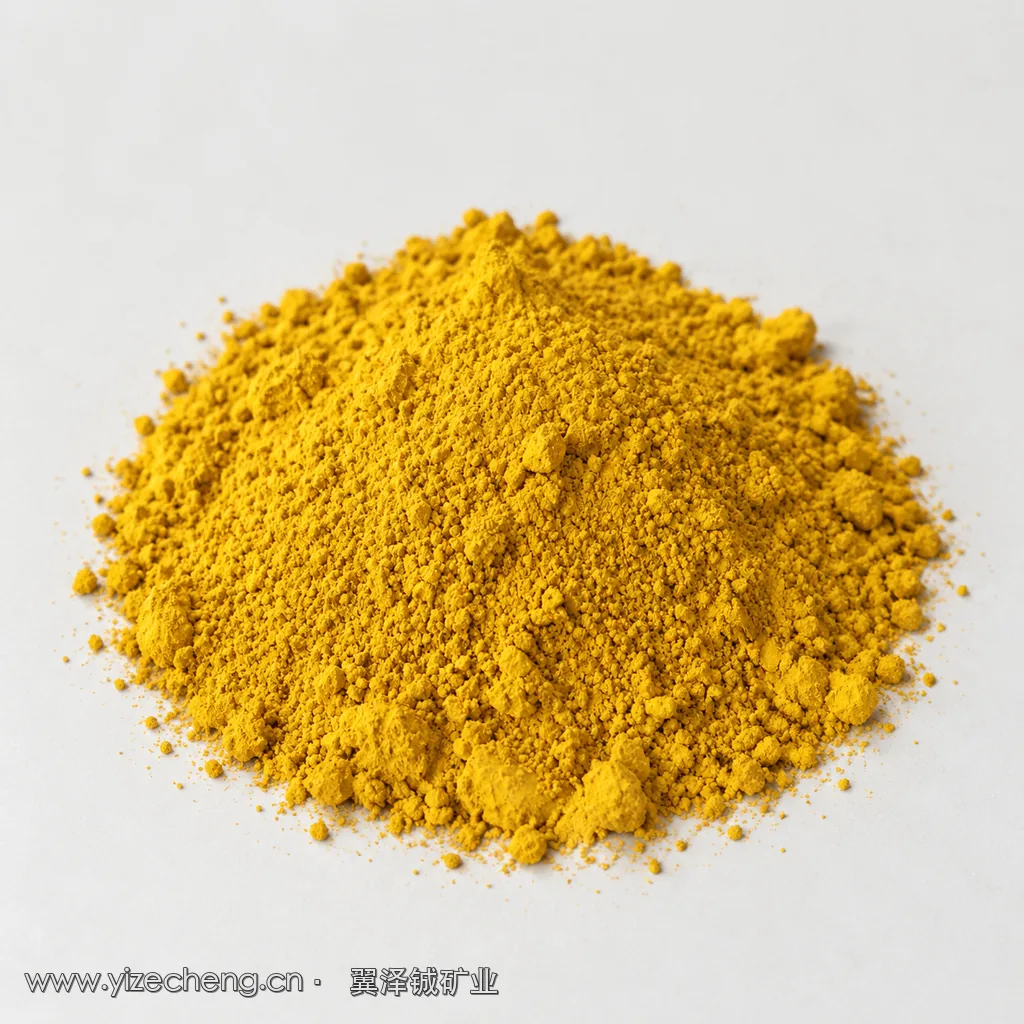
What colour is iron oxide yellow? The range runs from lemon yellow to brownish yellow. General-purpose 313 sits at the standard yellow; other grades move towards green or red. Define the hue with a physical standard sample in the enquiry.
Does it dissolve in water? No. It colours by dispersion rather than dissolution, which is why dispersion technique and grind fineness directly affect the final shade.
Is it a hazardous material? Not under the main regulatory classifications, and it travels as general cargo. Powder handling still needs dust protection.
Why do quotations for the same “313” differ so much? Usually it comes down to content, relative tinting strength, residue on sieve and dispersibility, or to a hue shift. Ask for the certificate of analysis first and compare line by line.
What to put in your RFQ
Start with the application system and the hue requirement. Then check the certificate of analysis line by line against content, relative tinting strength, residue on sieve and moisture. Finally confirm packaging and the storage and transport conditions. GB/T 1863-2008 gives you the framework; the actual limits belong in the contract.
Related reading: Iron oxide yellow — grades and specifications | How to read ore grade and assay reports | Choosing between GCC and PCC